From Mill Street to Collins Avenue: The J.S. Collins Yard and the Shop That Shapes Townehaus
Townehaus is a custom American-made furniture studio at 300 Mill Street in Moorestown, New Jersey, in the historic John S. Collins & Son lumber yard. Collins, a Moorestown Quaker, built that yard in the late 1800s and later helped found Miami Beach — including the 1913 Collins Bridge and Collins Avenue.
If you have ever come to see us here, you already know the feeling of the place before you know the history.
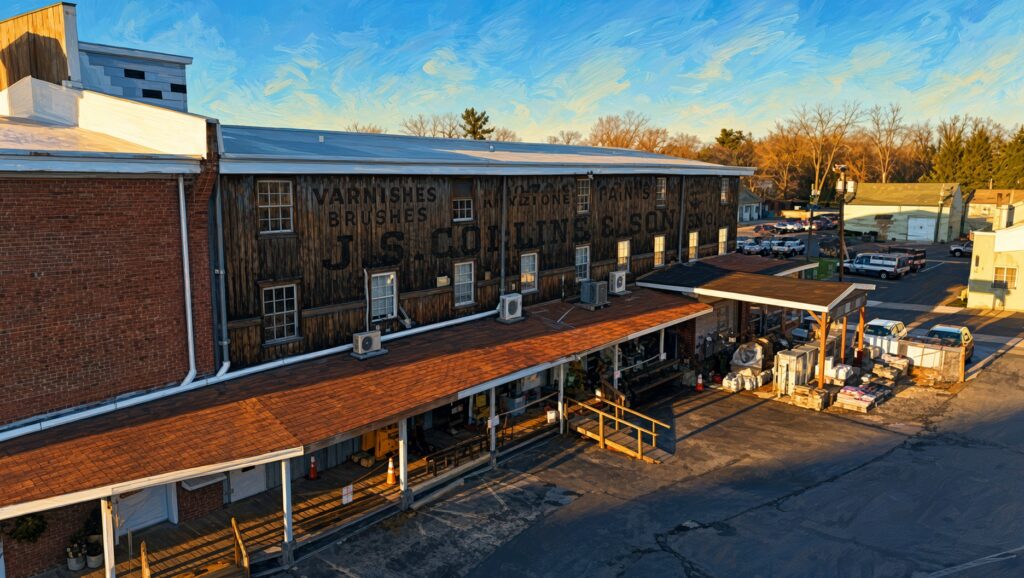
You turn off Mill Street, pass through the gate behind Moorestown Hardware, and find yourself in a yard that was never meant to look like a showroom. The buildings are working buildings. Brick and board. High windows. The kind of rooms designed around lumber, coal, feed, and the daily work of making a town. Our studio sits in that complex — in the old woodshop at the back of what was once J.S. Collins & Son.
We did not choose this address because it photographed well. We chose it because it feels true. Every day we design and specify furniture meant to last for generations, and we do it inside buildings that have already done exactly that.
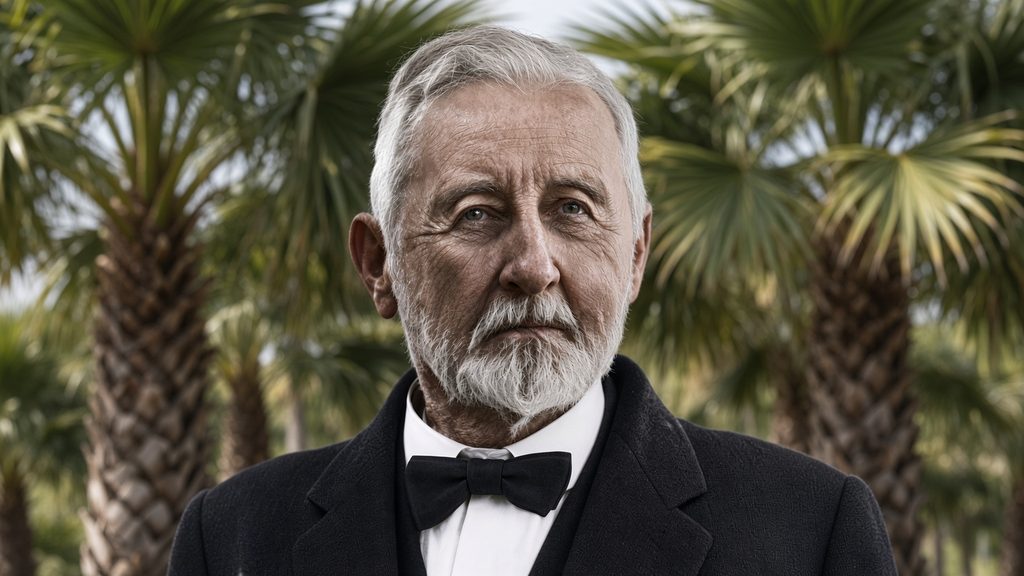
Who was John S. Collins of Moorestown?
John Stiles Collins (1837–1928) was a Moorestown Quaker farmer, nurseryman, and merchant. He built the J.S. Collins & Son lumber, coal, and hardware yard on Mill Street, then became a founding developer of Miami Beach.
He was born here on December 29, 1837, the sixth generation of his family to work land that had been in Collins hands since 1678. They were Friends. The values that come with that — usefulness, plain dealing, patience, a suspicion of waste — were not branding. They were how a family stayed on the same ground for two hundred years.
At eighteen, in 1855, Collins opened Pleasant Valley Nurseries off what was then Elbow Lane, now Pleasant Valley Avenue. He was a horticulturist before he was a merchant: Kieffer pears, Wilson blackberries, orchards that eventually numbered in the tens of thousands of trees. South Jersey knew the Collins name for growing things long before Florida did.
The nursery needed a supply yard. That yard became something larger. On the land around Mill Street and the railroad, Collins established a coal and lumber business with a hardware store, a lumber mill, a feed mill in the multi-story brick section at the rear, and farm implements for the surrounding countryside. By the end of the century it was J.S. Collins & Son — his son Irving running the New Jersey operation — with branches in several towns across Burlington and Camden Counties. Maple Shade opened a yard of its own in 1917.
Where is the old Collins lumber yard today?
The yard is still on Mill Street in Moorestown, at 300 Mill Street. Moorestown Hardware occupies the historic front building. Townehaus is in Suite N, in the old woodshop at the back of the complex.
The hardware building that anchors the corner dates to the late nineteenth century. Local accounts put the rustic lumber-yard structure around 1879. The painted wall still reads J.S. Collins & Son, along with the old trade lines for varnishes, brushes, and paints. The complex operated as a lumber yard into the early 1970s. The mill across Mill Street burned in that decade. What survived was not a museum. It was a working yard that refused to disappear.
Moorestown Hardware reopened in the historic building in 1974. Cabinetmakers followed. Artists and tradespeople filled the outbuildings. When Carrie and I opened Townehaus here in 2023, we were not the first people on this property to take raw wood seriously. We were joining a conversation that had already been going on for more than a century.
How does the historic woodshop shape Townehaus designs?
Designing furniture in a place that once sold the boards keeps the work honest. The Collins yard was built for weight, inventory, and use — not display — and that logic still sits in our drawings.
There is a difference between designing in a white-box studio and designing here.
The Collins yard was never ornamental. It sat where the railroad met the street so timber, coal, and feed could move. The rooms still have that logic. Light comes in the way it comes into a mill, not a boutique. The floors remember weight. You can feel, even now, that this was a place of inventory and sawdust and practical answers.
That atmosphere does something to the work.
It keeps us honest about construction. When you spend your days in buildings that have outlasted several generations of fashion, it becomes harder to fall in love with a detail that will not survive real life. We design for solid wood, honest joinery, and finishes that can be lived with — not because that is a marketing line, but because the room itself will not let you pretend otherwise.
It also keeps the work warm. Moorestown is not a cold town, and this yard is not a cold place. Quaker Moorestown was never about austerity for its own sake. It was about making things well enough that they could be used, shared, and passed along. That is the difference between “minimal” and “enough.” Our pieces tend to sit in that middle ground: Shaker clarity with a sculptural line, tradition with the tools of now, rooms that feel collected rather than staged.
Clients often say the showroom feels like a workshop that decided to become a home. That is not an accident. The property taught us that.
We are also not working here alone. For decades this yard has held cabinetmakers, flooring shops, artists, and the hardware store that still serves as the front door of the block. The place has a memory of craft even when the original mill is gone. Townehaus belongs to that lineage: American-made furniture, specified and shown in a yard that once supplied the town with wood.
What is John Collins’s connection to Miami Beach?
Collins did not found the City of Miami. He and his family named Miami Beach, built the 1913 Collins Bridge across Biscayne Bay, and opened the island to development. Collins Avenue is named for him.
Here is the part that still surprises people.
In 1891 — the same stretch of years when Collins was filing a plan of lots at Lenola and running the lumber-and-nursery business at home — he began buying land on a mangrove barrier island between the City of Miami and the Atlantic. He did not go south to invent a resort. He went as a grower. Coconuts first, then mangoes and avocados, which the markets still called alligator pears. He bought out his New Jersey partners and ended up with roughly five miles of island, about fifty blocks of what is now Miami Beach. By 1909 the plantings were being described as the world’s largest avocado grove.
The land was fertile and nearly impossible. Crops had to be hauled through mangroves and ferried across Biscayne Bay. Collins, already in his seventies, dredged a canal — Collins Canal — to shorten the trip. His family in Moorestown agreed to put more money in on one condition: he had to build a bridge. Without a bridge, the farm stayed a farm. With a bridge, the island could become a place.
In 1911 the family formed the Miami Beach Improvement Company. It is the first recorded use of the name “Miami Beach.” Construction on a two-and-a-half-mile wooden toll bridge began in 1912. When the money ran short, seventy-four-year-old Collins made a deal with the automobile pioneer Carl G. Fisher: the capital to finish the span in exchange for two hundred acres. Fisher later called him “a bantam rooster, cocky and unafraid.” The Collins Bridge opened on June 12, 1913. At the time it was said to be the longest wooden vehicular bridge in the world.
The City of Miami already existed. What Collins and his family did was connect it to the island, name the beach, and open the ground on which a city could be built. Collins Avenue still runs the length of Miami Beach. Collins Park and Collins Canal carry the name. His son-in-law, Thomas J. Pancoast — also from Moorestown — became the second mayor of Miami Beach. Collins died there in 1928, at ninety, and was buried back in Camden County.
He did not abandon New Jersey. Irving kept the lumber business. Arthur kept the orchards. The Mill Street yard continued. One life held both: the quiet industrial block behind a Quaker town, and the bridge that made a famous American shoreline possible.
Why that story belongs in our work
We are not in the business of building cities. We are in the business of building rooms that last. The Collins story matters to us because the instincts are the same.
He started with growing things, then built the structure the work required. We start with wood and the way a family actually lives, then we design the piece that will hold up. The canal and the bridge were not vanity. They were infrastructure for a harvest. A well-made table is infrastructure for a household.
He was willing to change the plan without changing the standard. The Florida farm did not remain a farm. Tourism overtook the groves. Collins adapted, but he did not become careless. That is a useful model in furniture. Trends move. Construction should not.
He thought in decades, at an age when most people are finished. A seventy-four-year-old Quaker from Moorestown finishing a two-and-a-half-mile wooden bridge is not a story about hustle. It is a story about the long view. We tell clients the same thing about a dining table or a bed: if it is designed and built correctly, you should not have to think about replacing it. You should think about who sits there next.
He carried Moorestown with him. The Miami chapter is spectacular. The New Jersey chapter is the one we inhabit. The lumber yard, the nursery, the hardware counter, the Friends meetinghouse culture of this town — that is the soil. Our name points at Moorestown life on purpose. “Towne” is not decoration. It is the belief that a place can still make things of consequence.
When we talk about a New American aesthetic — Shaker bones, sculptural presence, American workshops, pieces that look as if they have already been loved — we are talking about that soil. Not copies of old furniture. Not disposable new furniture. Something that could only come from a town that still knows who built the mill, and from makers who still know how to use a board.
Every time we walk the lot, we are walking ground that supplied Moorestown with lumber while its owner was planting avocados a thousand miles away. The hardware store at the street is the civic face of the old yard. The building at the back is where we meet clients, spread samples, and talk through a house the way Collins once talked through a grove or a bridge: what will this have to carry, and for how long?
That question is the whole business.
The world does not need more disposable furniture. It needs pieces with a reason to exist and the construction to survive their reason. Working in the Collins yard makes that argument without a speech. The buildings already made it.
If you come for an appointment or an Open Haus, take a minute in the parking lot before you come inside. Look at the brick. Look at the painted name. Look at the way the complex still works as a collection of trades. Then come in and sit at a table that was designed in that same spirit — not to impress a season, but to belong to a household the way this yard has belonged to Moorestown.
Frequently asked questions
Where is Townehaus located?
300 Mill Street, Suite N, Moorestown, NJ 08057, in the historic Collins Lumber Yard behind Moorestown Hardware.
Who was John S. Collins?
John Stiles Collins (1837–1928) was a Moorestown Quaker farmer and nurseryman who built J.S. Collins & Son, a lumber, coal, and hardware business on Mill Street, then became a founding developer of Miami Beach.
Did John Collins found Miami?
No. He did not found the City of Miami. He and his family named Miami Beach, built the 1913 Collins Bridge across Biscayne Bay, and developed the island. Collins Avenue is named for him.
Why does Townehaus work in the old woodshop?
The late-1800s yard was built to handle real lumber. Designing heirloom solid-wood furniture there keeps the work honest — construction first, trend second.
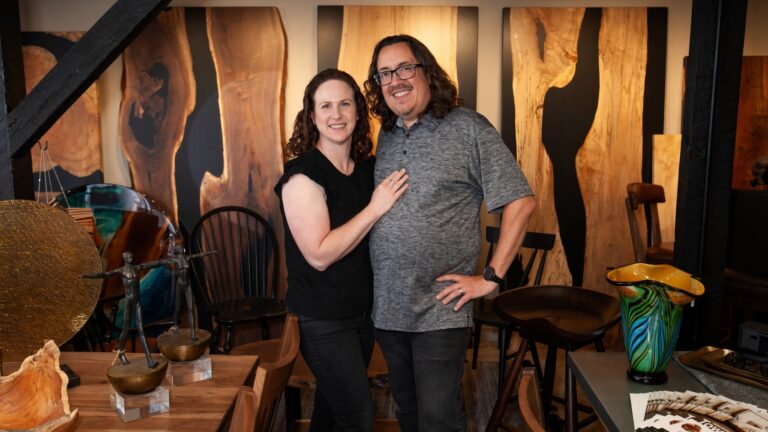
Townehaus is the showroom and design studio of Michael and Carrie Robinson. Visits are by appointment. Open Haus dates are posted on Instagram @townehaus.
Book a showroom appointment: https://townehaus.com/book-showroom-appointment/
Sources for the historical record: Historical Society of Moorestown; Maple Shade History research on the Rogers/Collins families; the Moorestown Historic District National Register nomination; accounts of J.S. Collins & Son and Moorestown Hardware; biographies of John S. Collins, the Collins Bridge, and the Miami Beach Improvement Company.