Quality furniture is not a finish sample or a warranty card. It is solid materials, honest joinery, and construction that still holds after kids, seasons, and twenty years of use. At Townehaus that means American-made solid hardwood, built to be kept — in the details you see and the ones you don’t.
Quality is not a department.
It is not a tag sewn into a cushion or a word printed on a hangtag. Quality is a set of decisions made long before a piece arrives in your house — and a set of decisions you live with long after the showroom lights are off.
What quality furniture looks like in the room
You notice the grain first. On a quartersawn white oak table it reads like architecture, not wallpaper. You notice the thickness of a top, the way a door sits in its opening, the quiet of a drawer that closes on its own weight instead of a cheap slide. You notice proportion: a case that feels settled in the room instead of perched on it.
Those things are not decoration. They are the result of someone deciding the piece had to look right from across the room and from two feet away, in morning light and in the evening, with a stack of mail on it and without.
Most furniture is designed to photograph well. Ours is designed to still look like itself when your kids are grown.
How to tell if furniture is well built (the parts you never see)
This is where most furniture quietly fails.
A lot of what is sold as “wood” is a thin skin of veneer over a core that will not last. It looks fine on day one. Then the seasons change, a house gets dry in winter, a glass leaves a ring, a child leans on the edge, and the piece starts telling on itself.
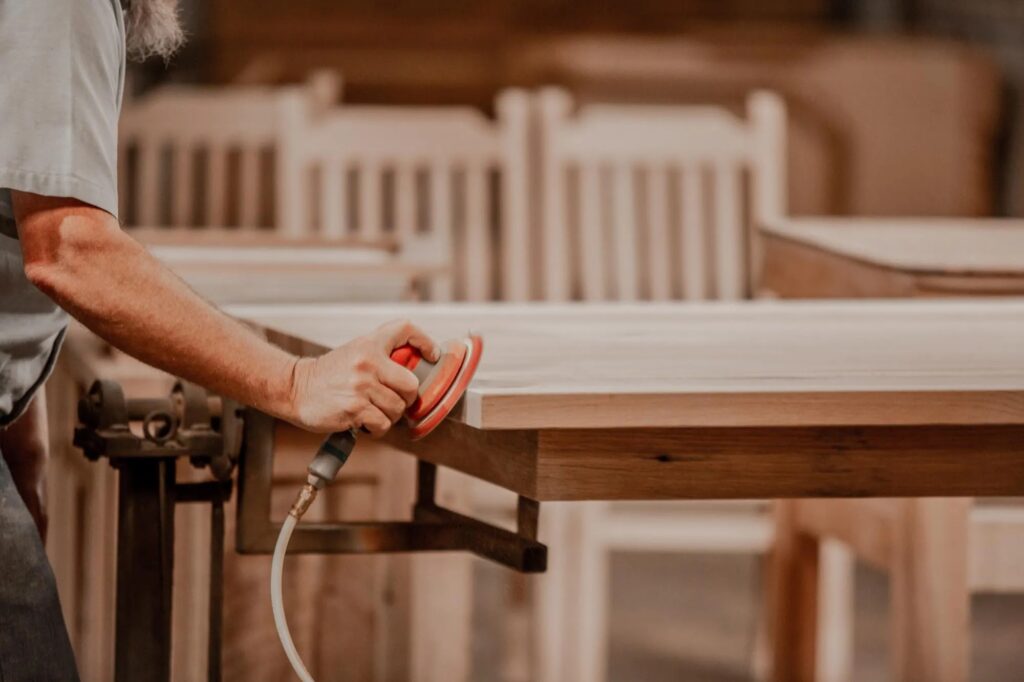
The furniture we stand behind is built from solid American hardwoods — brown maple, cherry, red oak, quartersawn white oak, and others — properly dried so the wood can move the way wood moves and not tear itself apart. Panels are allowed to float. Joints are made to hold. Drawer boxes are built as furniture, not as an afterthought. Finishes are chosen so they can be lived on and, when the time comes, renewed instead of discarded.
You will not see most of that work once the piece is in the room. That is the point. Quality that only exists on the surface is styling. Quality that exists underneath is construction.
| Fast furniture | Heirloom construction | |
| Core | Particle board or thin veneer over a cheap substrate | Solid American hardwood |
| Joints | Staples, cams, and glue | Mortise-and-tenon, dovetails, floating panels |
| Drawers | Stapled box, short slides | Solid-wood box, built to open every day for decades |
| After 10 years | Replace it | Refinish it and keep it |
Is Amish or American-made furniture actually better?
Not automatically. “Amish” and “Made in the USA” are not magic words. The shop still has to dry the wood correctly, allow for movement, and refuse the shortcuts that make a piece cheaper to ship.
I have spent twenty years walking factory floors in Indiana, Ohio, and Pennsylvania. The best shops I work with are not museums. They are working rooms where multi-generational skill meets tools that make the work more precise, not cheaper.
Tradition without rigor becomes costume. Technology without a standard becomes speed for its own sake. The combination that matters is simple: someone who knows how a table should be built, and the means to build it that way every time — including the one-off size, the unusual stain, the piece that has to fit a specific wall in a specific house.
That is why we customize. Not because options are a marketing program, but because a dining table that is two inches too wide or a dresser that almost fits the niche is not quality. It is a compromise you will feel every day.
How long should good furniture last?
Furniture is not an accessory. It takes the weight of people. It takes sunlight, wet glasses, backpacks, and the slow passing of years. The question is not whether a piece looks current this season. The question is whether you will still want it — and whether it will still hold together — when the house has a different life in it.
A well-built solid-wood table or dresser should outlast the house it first sits in. That is not romance. That is joinery, species, drying, and a finish that can be renewed. Heirloom construction is also the more honest environmental choice. A table that lasts thirty years does not need to be replaced four times. The people who built it keep their shops open. The wood was worth cutting.
That is the standard we use when we design a collection, when we choose a line for the showroom, and when we sit at someone’s kitchen table with a tape measure and a floor plan.
What we will not do
We will not carry a piece because it is trending.
We will not tell you something is solid wood when it isn’t.
We will not rush a conversation that needs an hour.
Real design takes real time. Quality does too.
If you are the kind of person who would rather buy once than buy twice, that is who this studio is for. Bring the problem, the inspiration images, or just the room that has never quite worked. We will look at what you can see — and we will talk about what you cannot.
The world does not need more furniture that ends up on the curb.
It needs more pieces worth keeping.
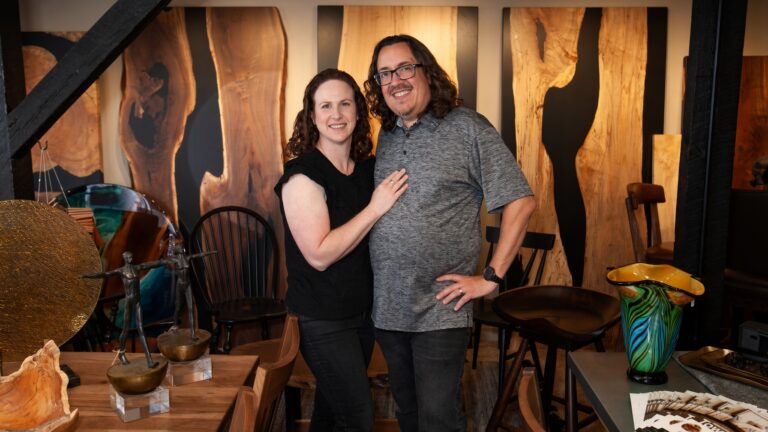
— Michael Robinson
Co-owner and furniture designer, Townehaus
300 Mill Street, Suite N, Moorestown, NJ
By appointment. Call or text 856-581-0378.
FAQ
What does quality really mean in furniture?
Quality means the piece is built from honest materials, joined so it can take daily use, and finished so it can be lived on and later renewed. It is not a hangtag. It is whether the table, dresser, or bed still feels right — and still holds together — twenty years from now.
What is heirloom-quality furniture?
Heirloom-quality furniture is designed to be kept, repaired, and passed on. Solid hardwood, proper drying, and joinery that allows wood to move with the seasons matter more than a trend-driven silhouette. The goal is a piece that can change houses with a family instead of going to the curb.
How can you tell solid wood from veneer?
Look at edges, undersides, and the inside of drawers. Solid hardwood shows consistent grain through the thickness of a top or panel. Veneer is a thin slice of real wood over particle board or plywood; once the face is damaged, there is often nothing to refinish. Weight helps, but construction tells you more than weight alone.
Does heavier furniture mean better quality?
Not always. Solid hardwood and real joinery usually feel substantial, but weight can also come from cheap cores or overbuilt bases. Open a drawer. Check how a door hangs. Ask what the case is made of underneath the finish. Those answers matter more than picking the piece up once.
Is American-made or Amish furniture worth it?
It can be, when the shop dries the wood correctly and builds joints that last. The value is not the label. It is access to solid hardwood, custom sizing, and makers who will still be there if a piece needs service years later. That is why we work with shops in Indiana, Ohio, and Pennsylvania we have known for years.
How long should a well-built dining table or dresser last?
A well-built solid-wood piece should last decades, not a product cycle. Tops can be refinished. Joints should stay tight if the wood was dried and allowed to move. If you expect to replace it in five or ten years, it was never built as furniture you keep.